Local SEO is the process of improving a business’s online presence so it appears in search results when people look for products or services in a specific area. It helps businesses increase visibility in Google Search and Maps, attract nearby customers, generate more enquiries, and compete more effectively in their local market.
Introduction
Your business may offer a great service, have competitive prices, and have happy customers. But if people searching for that service online cannot find you, your competitors are getting the opportunities that could have been yours.
That is where local SEO comes in.
Local SEO is the process of improving your online presence so your business can appear more prominently when people search for products or services in a specific area. It helps search engines understand what your business does, where you operate, and which customers your business is relevant to.
For businesses that serve customers in a particular geographic area, local SEO can help generate more visibility, website visits, calls, enquiries, bookings, and visits to your physical location.
In this guide, we will explain what local SEO really is, how it works, why it matters, and the key areas you need to focus on to build a strong local search presence.
Table of Contents
What Is Local SEO?
Local SEO (Local Search Engine Optimisation) is the practice of optimising a business’s online presence to improve its visibility in search results for geographically relevant searches.
For example, someone might search for:
- “plumber near me”
- “best coffee shop nearby”
- “dentist in [city]“
- “car rental near me”
- “SEO agency in [city]“
- “emergency electrician”
These searches have local intent because the person is looking for a business that serves a particular area.
Local SEO helps search engines determine which businesses are relevant to these searches and which ones should be displayed to the searcher.
It is not simply about adding a city name to your website. A successful local SEO strategy involves your Google Business Profile, website, reviews, business information, local content, citations, links, and overall online reputation working together.
Why Does Local SEO Matter for Local Businesses?
People often search online before deciding which local business to contact.
They may compare several businesses, read reviews, check opening hours, look at photos, visit a website, or call directly from the search results.
If your business is difficult to find, you are missing potential customers before they ever reach your website or speak to your team.
Local SEO can help your business:
- Appear in relevant local searches
- Increase visibility on Google Maps and local search results
- Generate more calls and enquiries
- Bring more qualified visitors to your website
- Build trust through reviews and online information
- Compete with larger businesses
- Reach customers who are actively looking for your services
The important point is intent.
Someone searching for “plumber near me” is usually much closer to making a decision than someone casually reading an article about plumbing.
Local SEO helps your business become visible at that important moment.
Turn Local Searches Into Real Customers
Your customers are already searching for the services you offer. With the right local SEO strategy, Rankmatric helps your business get discovered, attract qualified leads, and turn local searches into real customers.
How Does Local SEO Work?
Google considers several signals when deciding which businesses to show for local searches.
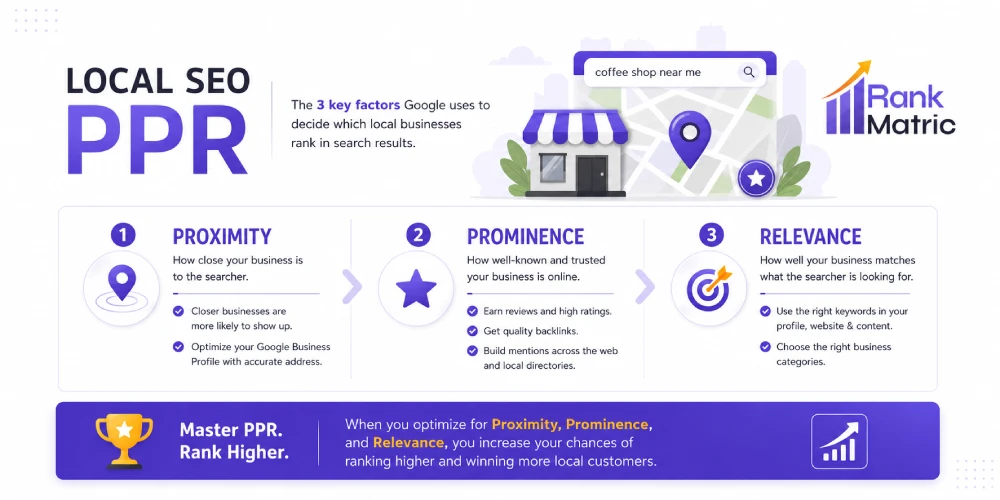
Three important concepts are relevance, proximity, and prominence.
Relevance
Relevance refers to how closely a business matches what the person is searching for.
Google needs to understand what your business offers before it can decide whether your business is a suitable result.
Your business category, services, website content, Google Business Profile, and other online information all help communicate this information.
The clearer and more consistent your business information is, the easier it is for search engines to understand your relevance.
Proximity
Proximity refers to the distance between the searcher and businesses that could satisfy their search.
For searches with local intent, location can have a major influence on the results.
You cannot completely control where a searcher is located, but you can make sure your business location and service areas are accurately represented across your online presence.
Prominence
Prominence refers to how established, trusted, and well-known a business appears to be online and offline.
Signals can include things such as:
- Customer reviews
- Links from other websites
- Business mentions and citations
- Brand visibility
- Website authority
- The overall quality and completeness of your online presence
A business with a strong reputation and well-established online presence may have an advantage over a business that provides a similar service but has very little information available online.
The Core Elements of a Strong Local SEO Strategy
Local SEO is not one single task. It is a combination of several activities that work together.
1. Google Business Profile Optimisation
Your Google Business Profile is one of the most important parts of your local SEO presence.
It is the business profile that can appear in Google Search and Google Maps when people search for your business or services.
A properly maintained profile should contain accurate and useful information, including:
- Business name
- Primary business category
- Relevant secondary categories
- Address or service area
- Phone number
- Website
- Opening hours
- Services
- Business description
- Photos
- Other relevant business information
Keeping this information accurate helps both customers and search engines understand your business.
Your Google Business Profile should also be actively maintained rather than treated as something you set up once and forget.
2. Consistent Business Information
Search engines use information from many different sources to understand a business.
This makes consistency important.
Your business name, address, phone number, website, and other important details should be accurate wherever your business is listed online.
For example, if your business address or phone number is different across important platforms, it can create confusion for both customers and search engines.
This is why local SEO often includes checking and correcting business information across the web.
3. Local Citations
A citation is an online mention of your business, commonly including information such as your business name, address, and phone number.
Citations can appear on:
- Business directories
- Industry websites
- Local directories
- Review platforms
- Chamber or association websites
- Relevant business listing websites
The goal is not to submit your business to hundreds of low-quality directories.
Quality and relevance matter more than quantity.
A smaller number of trustworthy and relevant listings can be more valuable than a large number of poor-quality listings.
4. Reviews and Reputation
Online reviews play an important role in local search and customer decision-making.
Before contacting a business, many people look at its reviews to understand what previous customers experienced.
A strong review profile can help build trust and make your business more attractive to potential customers.
A good review strategy should focus on generating genuine customer feedback rather than trying to manipulate ratings.
Encourage satisfied customers to leave honest reviews, make the process easy, and respond professionally to both positive and negative feedback.
Never rely on fake reviews or incentivised reviews that violate platform guidelines.
5. A Well-Optimised Website
Your Google Business Profile is important, but your website is still a major part of local SEO.
Your website should clearly communicate:
- What your business does
- Which services you provide
- Who you serve
- Where you operate
- How customers can contact you
- Why customers should choose you
Your main service pages should be properly optimised for the searches your potential customers actually use.
This includes elements such as:
- Page titles
- Headings
- Website copy
- Internal links
- Images and alt text
- Meta descriptions
- Structured data where appropriate
- Mobile usability
- Page speed
- Clear calls to action
The objective is not to stuff keywords into every page.
The objective is to make the website clear, useful, trustworthy, and relevant to both users and search engines.
6. Location and Service Area Pages
If your business genuinely serves multiple areas, dedicated location or service-area pages can help communicate that to search engines and customers.
However, creating dozens of nearly identical pages simply by replacing a location name is not a strong strategy.
Each page should provide genuine value.
A useful location page might explain:
- Which services you provide there
- Who you serve
- Relevant local considerations
- How customers can contact you
- Why your business is suitable for that area
Only create location pages for areas you genuinely serve.
7. Local Keyword Research
Keyword research helps you understand what potential customers are actually searching for.
Local keyword research can uncover searches based on:
- Services
- Products
- Problems
- Locations
- “Near me” searches
- Commercial terms
- Questions
- Specific customer needs
For example, a business should not only target broad terms such as “electrician.”
It may also need to understand searches such as:
- “emergency electrician”
- “electrician near me”
- “residential electrician”
- “commercial electrician”
- “electrical repair service”
The exact keywords will depend on the business, its services, and its customers.
Good local SEO focuses on search intent, not simply inserting location keywords into a page.
8. Local Content
Content can support your local SEO strategy by answering questions your target customers are asking.
This could include:
- Service guides
- Local buying guides
- Frequently asked questions
- Pricing information
- Problem-solving articles
- Comparison guides
- Customer resources
- Area-specific information
The best local content is created for people first.
Instead of producing hundreds of thin articles just to target keywords, create useful resources that demonstrate your knowledge and help potential customers make better decisions.
9. Local Links and Brand Mentions
Links from other relevant and trustworthy websites can help strengthen your website’s authority.
For local businesses, useful links may come from:
- Local organisations
- Industry associations
- Relevant publications
- Community organisations
- Business partnerships
- Local events
- Suppliers and professional networks
Again, quality matters.
The objective is not to build as many links as possible. It is to build a credible online presence that naturally demonstrates that your business is legitimate and relevant.
Local SEO vs. Traditional SEO: What’s the Difference?
Local SEO and traditional SEO share many of the same foundations, but their goals are different.
Traditional SEO generally focuses on improving a website’s visibility for searches regardless of where the searcher is located.
Local SEO focuses on searches where geographic relevance matters.
For example, an online store selling products nationwide may focus heavily on product and category keywords.
A local service business, on the other hand, needs to be visible when potential customers search for its services in the areas it serves.
Local SEO therefore places greater emphasis on things such as:
- Google Business Profile
- Google Maps visibility
- Local reviews
- Business information
- Local citations
- Location relevance
- Local links and mentions
The two approaches are not competitors.
In many cases, the strongest strategy combines traditional SEO with local SEO.
Common Local SEO Mistakes
Many businesses struggle with local search visibility because they overlook basic issues.
Some of the most common mistakes include:
Incomplete Google Business Profile
Businesses sometimes create a profile but leave important information missing or outdated.
Inconsistent Business Information
Different business names, phone numbers, addresses, or other details across the web can create unnecessary confusion.
Ignoring Reviews
Some businesses collect reviews but never respond to them or develop a consistent process for generating genuine customer feedback.
Keyword Stuffing
Adding the same location and service keywords repeatedly does not make a page better.
Content should be natural and useful.
Creating Thin Location Pages
Creating dozens of almost identical pages with only the location name changed can produce little value for users.
Ignoring the Website
Local SEO is not only about Google Maps. Your website needs to provide useful information and support the customer’s decision-making process.
Focusing Only on Rankings
Ranking is important, but rankings are not the final goal.
The real objective is to generate qualified traffic, calls, enquiries, bookings, and customers.
How Long Does Local SEO Take to Show Results?
There is no universal timeline for local SEO.
Some businesses may notice improvements relatively quickly, while others may require several months of consistent work.
The timeline depends on factors such as:
- Competition
- Current website quality
- Existing authority
- Google Business Profile strength
- Review history
- Business age and reputation
- Website technical health
- Quality of local signals
- Existing rankings
- The quality of the SEO strategy
Local SEO should therefore be treated as an ongoing process rather than a one-time task.
The goal is to continuously improve your visibility, relevance, authority, and ability to convert searchers into customers.
How to Measure Local SEO Success
Local SEO should not be measured only by keyword rankings.
Important performance indicators can include:
- Local search visibility
- Google Business Profile interactions
- Website traffic from local searches
- Phone calls
- Direction requests
- Contact form submissions
- Bookings
- Leads
- Conversion rate
- Revenue generated from organic and local search
A business ranking in the top three is useful, but if that visibility produces no enquiries or customers, something else needs to be improved.
The best local SEO strategy connects search visibility with business results.
Why Local SEO Is an Investment, Not a One-Time Task
Search results change. Competitors improve. Customers’ search behaviour changes. Your business may add services or expand into new areas.
That means local SEO should not stop once your business reaches a good position.
A long-term strategy continuously monitors performance, updates important information, improves the website, builds reputation, creates useful content, and identifies new opportunities.
The businesses that consistently invest in their online presence are better positioned to maintain visibility as the search landscape changes.
Let Rankmatric Help Grow Your Local Search Visibility
Understanding local SEO is one thing. Building and maintaining a successful strategy is another.
At Rankmatric, we help businesses improve their visibility in local search by combining technical SEO, on-page optimisation, local search strategy, content, reputation signals, and ongoing performance analysis.
Whether you are starting from scratch or already have an established online presence, our approach focuses on the things that matter most: better visibility, relevant traffic, qualified leads, and measurable business growth.
Get Your Free SEO Audit
You can also explore our SEO services or browse our SEO resources and blog to learn more about growing your organic search presence.
Conclusion
Local SEO is about making it easier for potential customers to find, understand, and trust your business when they are searching for the products or services you provide.
It goes beyond simply ranking a website.
A strong local SEO strategy brings together your Google Business Profile, website, reviews, business information, local content, citations, links, and overall online reputation.
When these elements work together, search engines have a clearer understanding of your business and customers have more reasons to choose you.
You do not need to implement everything at once.
Start with the fundamentals: make your business information accurate, optimise your Google Business Profile, build a useful website, earn genuine reviews, create valuable content, and continuously improve your local search presence.
That is what effective local SEO is really about.