
SEO marketing is the process of improving a website’s visibility in search engines to attract relevant organic traffic, reach potential customers, build trust, and generate sustainable business growth without relying entirely on paid advertising.
If you have ever searched for something on Google and clicked one of the top results, you have already experienced the power of SEO marketing.
For businesses, appearing prominently in search results can mean more visibility, more website visitors, more enquiries, and more customers. But getting there requires more than simply adding keywords to a website.
This guide explains what SEO marketing is, how it works, its main components, its benefits, common mistakes, and how to build an effective SEO strategy for your business.
Table of Contents
What Is SEO Marketing?
SEO marketing, or Search Engine Optimization marketing, is the practice of improving a website’s visibility in search engines such as Google and Bing.
The goal is to help your website appear when people search for products, services, information, or solutions related to your business.
For example, if someone searches for “accounting services,” “best running shoes,” or “how to fix a leaking tap,” search engines need to decide which pages are most useful and relevant to that search.
SEO helps your website become a stronger candidate for those results.
Unlike paid advertising, where you pay for every click or impression, SEO focuses on earning organic visibility through useful content, strong website performance, relevance, authority, and a positive user experience.
SEO is therefore not simply about ranking higher.
Good SEO connects your business with people who are already searching for what you offer.
What Does SEO Stand For?
SEO stands for Search Engine Optimization.
It refers to the strategies and practices used to improve a website’s visibility in organic search results.
SEO involves many areas, including keyword research, content optimisation, technical SEO, internal linking, website structure, backlinks, user experience, and ongoing performance analysis.
How Does SEO Marketing Work?
Search engines need to discover, understand, and evaluate billions of web pages before deciding which results to show for a particular search.
SEO helps make your website easier to discover and understand while demonstrating that your content deserves to be shown to searchers.
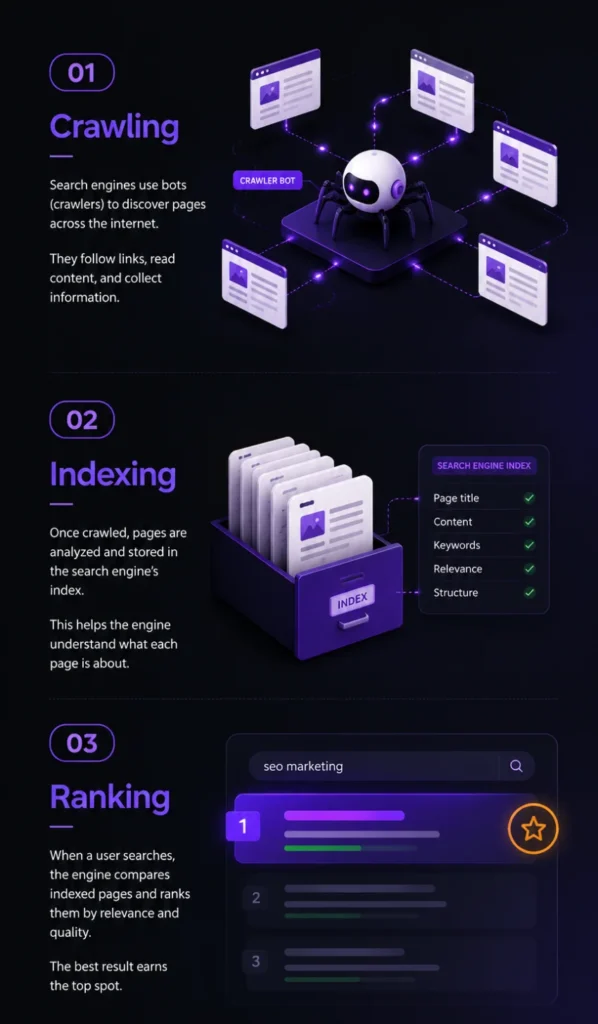
There are three basic stages involved.
Crawling
Search engines use automated programs called crawlers or bots to discover and read pages across the web.
When a crawler visits your website, it follows links and examines your pages to understand their content and structure.
Indexing
After discovering a page, the search engine may store its information in its index.
The index is essentially a massive database of web pages that search engines can use when responding to searches.
If a page cannot be properly accessed or indexed, it may not appear in search results.
Ranking
When someone performs a search, the search engine evaluates relevant pages and determines which results are most useful for that particular query.
Many different signals can influence rankings, including relevance, content quality, website structure, authority, links, usability, and the context of the search.
SEO marketing aims to improve these areas so your pages have a stronger opportunity to appear for relevant searches.
Key Components of SEO Marketing
SEO is not a single technique.
A successful SEO strategy combines multiple areas that work together to improve visibility and organic performance.
1. Keyword Research
Keyword research is the process of discovering what your target audience searches for on search engines.
It helps you understand:
- What people are searching for
- How often they search
- What their intent is
- How competitive a topic is
- Which searches could bring valuable traffic
- What content or pages should be created
Good keyword research is about more than finding keywords with high search volume.
You also need to understand search intent.
Someone searching for “what is SEO” is looking for information.
Someone searching for “SEO agency” may be looking for a service provider.
Someone searching for “SEO pricing” may already be comparing their options.
Understanding this difference helps you create the right page for the right search.
2. On-Page SEO
On-page SEO involves optimising the content and structure of individual pages.
This can include:
- Page titles
- Headings
- Content
- URLs
- Meta descriptions
- Internal links
- Images and alt text
- Content structure
- Keyword usage
- Search intent alignment
The objective is not to insert a keyword as many times as possible.
Modern SEO is about creating a page that clearly satisfies the searcher’s needs while making the topic understandable to search engines.
3. Technical SEO
Technical SEO focuses on the technical foundation of your website.
It helps search engines crawl, understand, and index your pages while also improving the experience for visitors.
Important areas can include:
- Website speed
- Mobile usability
- Core Web Vitals
- HTTPS
- XML sitemaps
- Robots.txt
- Canonical URLs
- Redirects
- Broken links
- Crawlability
- Indexing
- Structured data
- Website architecture
A technically strong website gives your content and other SEO efforts a better foundation to perform.
4. Off-Page SEO and Link Building
Off-page SEO refers to activities that happen outside your own website that can influence your site’s authority and reputation.
One of the most important areas is backlinks.
A backlink is a link from another website to your website.
High-quality, relevant links can help search engines understand that other websites recognise your content or business as a useful resource.
Effective link building focuses on earning relevant links through things such as:
- Digital PR
- Original research
- Useful resources
- Industry relationships
- Expert contributions
- Valuable content
- Genuine business partnerships
The goal should be quality and relevance, not collecting hundreds of low-quality links.
5. Content Marketing
Content is one of the biggest components of modern SEO marketing.
Businesses can use content to answer questions, educate potential customers, demonstrate expertise, and attract people at different stages of the buying journey.
SEO content can include:
- Blog posts
- Service pages
- Product pages
- Guides
- Tutorials
- FAQs
- Comparison pages
- Case studies
- Research
- Industry resources
The best SEO content is created around real user needs rather than simply producing articles for the sake of publishing.
6. Local SEO
Local SEO is a specialised part of SEO for businesses that serve customers in a particular geographic area.
It helps businesses appear for searches where location is important.
Local SEO can involve:
- Google Business Profile optimisation
- Local keyword targeting
- Customer reviews
- Business citations
- Location pages
- Local links
- Consistent business information
If your business depends on customers in a specific area, local SEO can work alongside your broader SEO strategy to improve local visibility.
7. User Experience and Website Performance
SEO is not only about search engines.
The people who visit your website need to be able to use it easily.
A strong website should be:
- Fast
- Mobile-friendly
- Easy to navigate
- Easy to read
- Secure
- Clearly structured
- Helpful
- Easy to take action on
If visitors cannot quickly find what they need, they may leave and choose another business.
SEO and user experience should therefore work together rather than being treated as separate activities.
Why Does SEO Marketing Matter for Businesses?
SEO can become one of the most valuable long-term marketing channels for a business because it helps you reach people while they are actively searching.
Increase Organic Visibility
SEO can help your website appear for more relevant searches and expose your business to people who may not have discovered it otherwise.
Attract High-Intent Traffic
Search traffic can be particularly valuable because users are often actively looking for information, products, services, or solutions.
Someone searching for a specific service is already expressing an interest that other marketing channels may need to create from scratch.
Build Trust and Credibility
People often associate strong search visibility with established and credible businesses.
Consistently publishing useful content and building a strong online presence can further strengthen that trust.
Create Long-Term Value
Paid advertising can generate traffic while your budget is active.
SEO works differently.
A successful page can continue attracting organic traffic long after it is published, although rankings require ongoing monitoring and maintenance.
This makes SEO a long-term digital asset rather than simply another advertising expense.
Reduce Dependence on Paid Advertising
SEO and paid advertising can work together.
However, building strong organic visibility can reduce a business’s dependence on paying for every visitor over the long term.
Support the Entire Customer Journey
SEO is not limited to people who are ready to buy immediately.
You can create content for different stages of the customer journey:
Awareness:
Educational content that answers questions and introduces problems.
Consideration:
Comparison guides, detailed resources, and solution-focused content.
Decision:
Service pages, product pages, case studies, pricing information, and strong calls to action.
This allows SEO to support customers from their first search through to their final decision.
SEO vs Paid Search Marketing: What’s the Difference?
SEO and paid search both help businesses appear in search results, but they work differently.
SEO:
SEO focuses on earning organic visibility by improving relevance, content, authority, technical performance, and user experience.
Paid Search
Paid searchinvolves paying search engines to display advertisements for selected searches.
The main difference is how visibility is obtained.
With paid search, you can often gain visibility quickly, but you continue paying for traffic.
With SEO, results generally take longer to build, but successful rankings can generate organic traffic without paying for each individual click.
| Factor | SEO | Paid Search (PPC) |
|---|---|---|
| 💰 Cost Over Time | Decreasing | Ongoing Spend |
| ⚡ Speed of Results | Slow (3–6 Months) | Immediate |
| 📈 Traffic Sustainability | Long-Term Asset | Stops When Budget Ends |
| 🤝 Trust Level | Higher (Organic Results) | Lower (Ad Label) |
| 👆 Click-Through Rate | Generally Higher | Generally Lower |
| 🎯 Best For | Brand Building & Content Marketing | Quick Leads & Product Launches |
For many businesses, the best approach is not choosing one over the other.
SEO and paid search can complement each other by providing short-term visibility through advertising and long-term growth through organic search.
Types of SEO Marketing
SEO can be divided into several areas depending on what you are trying to achieve.
White Hat SEO
White hat SEO focuses on sustainable strategies designed to improve a website while following search engine guidelines.
This includes creating useful content, improving technical performance, earning quality links, and providing a good user experience.
Black Hat SEO
Black hat SEO uses manipulative tactics designed to exploit search engine algorithms.
Examples can include spammy link schemes, hidden text, keyword stuffing, and other attempts to artificially manipulate rankings.
These tactics can result in serious ranking and visibility problems.
On-Page SEO
On-page SEO focuses on improving individual pages through content, structure, keywords, headings, internal links, metadata, and other page-level elements.
Off-Page SEO
Off-page SEO focuses on signals outside your website, particularly links, mentions, reputation, and authority.
Technical SEO
Technical SEO focuses on the website’s infrastructure, crawlability, indexability, performance, and technical health.
Local SEO
Local SEO focuses on improving visibility for searches where geographic relevance matters.
E-commerce SEO
E-commerce SEO focuses on improving the visibility of online stores, products, categories, and other commercial pages.
It can involve product optimisation, category architecture, structured data, internal linking, content, and technical SEO.
International SEO
International SEO helps businesses reach audiences across different countries or languages.
It can involve international keyword research, multilingual content, country targeting, hreflang implementation, and international website structures.
Common SEO Marketing Mistakes to Avoid
SEO can produce excellent results, but poor strategy can waste significant time and resources.
Targeting the Wrong Keywords
High search volume does not automatically mean a keyword is valuable.
A keyword should be relevant to your business and have search intent that matches what you offer.
Keyword Stuffing
Repeating the same keyword excessively can make content difficult to read and does not create a better experience for users.
Use keywords naturally and focus on covering the topic comprehensively.
Creating Low-Value Content
Publishing hundreds of short or repetitive articles does not guarantee better rankings.
Every page should have a clear purpose and provide genuine value.
Ignoring Technical SEO
Excellent content can still struggle if search engines cannot properly crawl, index, or understand your website.
Building Low-Quality Backlinks
Large numbers of irrelevant or manipulative backlinks can create more problems than benefits.
Focus on earning relevant, trustworthy links.
Ignoring Existing Content
Businesses often focus entirely on creating new pages while overlooking pages that already have ranking potential.
Updating, improving, consolidating, and internally linking existing content can often uncover significant opportunities.
Expecting Instant Results
SEO usually takes time.
Search engines need time to crawl, evaluate, and rank changes, while competitive keywords may require significant authority and content development.
Measuring Only Rankings
Rankings are useful, but they are not the final goal.
A business should also track:
- Organic traffic
- Leads
- Sales
- Enquiries
- Conversion rates
- Revenue
- Search visibility
- Engagement
The real question is not simply “Did we rank?“
It is “Did SEO help the business grow?”
How Long Does SEO Take to Show Results?
There is no universal timeline for SEO.
Some websites may see early improvements within a few weeks, while competitive markets and new websites can require many months before significant results appear.
The timeline depends on factors such as:
- Website authority
- Competition
- Domain history
- Technical health
- Content quality
- Search intent
- Keyword difficulty
- Backlink profile
- SEO resources
- Consistency of execution
SEO should therefore be viewed as a long-term growth strategy rather than a quick marketing campaign.
The objective is not simply to achieve a temporary ranking.
It is to build an online presence that can continue generating qualified traffic and business opportunities over time.
How to Build an SEO Marketing Strategy
A successful SEO strategy should be based on research, priorities, execution, and continuous improvement.
Step 1: Audit Your Website
Start by understanding the current state of your website.
Identify technical problems, content weaknesses, ranking opportunities, backlink issues, indexing problems, and areas where competitors are outperforming you.
Step 2: Define Your Business Goals
SEO should support business objectives.
Decide whether your priority is:
- More leads
- More sales
- More organic traffic
- Brand visibility
- New customers
- Product discovery
- Market expansion
Your goals should determine your SEO priorities.
Step 3: Research Your Audience and Keywords
Understand what your potential customers search for and why.
Build a keyword strategy around relevance, search intent, competition, business value, and the different stages of the customer journey.
Step 4: Improve Your Website
Fix technical problems and improve important pages before constantly creating new content.
Make sure your website is fast, accessible, mobile-friendly, easy to navigate, and easy for search engines to understand.
Step 5: Build a Content Strategy
Create content based on genuine customer questions and business opportunities.
Prioritise topics that can attract relevant visitors and move them closer to becoming customers.
Step 6: Build Authority
Earn relevant backlinks, mentions, and recognition through valuable content, digital PR, partnerships, research, and industry expertise.
Step 7: Measure and Improve
SEO requires continuous analysis.
Monitor rankings, traffic, conversions, technical health, content performance, and competitor activity.
Then use the data to decide what to improve next.
SEO Marketing Tools Worth Knowing
SEO professionals use a variety of tools to research, analyse, monitor, and improve websites.
Google Search Console
Google Search Console provides information about how your website performs in Google Search, including search queries, clicks, impressions, indexing issues, and technical reports.
Google Analytics
Google Analytics helps you understand how people interact with your website and whether organic visitors are completing valuable actions.
Ahrefs and Semrush
These platforms provide tools for keyword research, competitor analysis, backlink analysis, rank tracking, and SEO research.
Screaming Frog
Screaming Frog can crawl websites and identify technical issues such as broken links, missing metadata, duplicate pages, redirects, and other technical problems.
Google Business Profile
For businesses that rely on local customers, Google Business Profile is an important part of managing their local search presence.
The Role of AI in SEO Marketing
AI is changing how people search, how businesses create content, and how SEO professionals work.
Search engines increasingly provide direct answers and AI-generated summaries alongside traditional organic results.
This means businesses need to focus even more on creating content that is:
- Accurate
- Useful
- Well-structured
- Original
- Trustworthy
- Relevant to search intent
AI can also help SEO professionals with tasks such as:
- Keyword research
- Content planning
- Data analysis
- Content briefs
- Internal linking ideas
- Competitor research
- Technical analysis
- Workflow automation
However, AI should be treated as a tool that improves SEO execution, not as a replacement for expertise, original thinking, research, or human judgement.
Simply producing large amounts of AI-generated content does not create a successful SEO strategy.
The businesses that benefit most from AI will be those that combine technology with genuine expertise, useful information, and strong editorial standards.
How Can an SEO Expert Help Your Business?
SEO is not particularly difficult to understand at a basic level.
The challenge is executing it consistently while keeping up with changing search behaviour, competitors, technical requirements, content opportunities, and search engine developments.
An experienced SEO professional can help you:
- Identify valuable opportunities
- Build a keyword strategy
- Improve existing pages
- Fix technical SEO issues
- Develop content strategies
- Build website authority
- Monitor competitors
- Track performance
- Connect SEO with business goals
The right SEO partner should not simply promise higher rankings.
They should understand how search visibility can contribute to actual business growth.
Turn Search Visibility Into Business Growth
Your potential customers are already searching for products, services, and solutions like yours. Rankmatric helps businesses turn that existing search demand into greater visibility, qualified traffic, enquiries, and long-term growth through strategic SEO.
Conclusion: SEO Marketing Is a Long-Term Growth Strategy
SEO marketing is about much more than ranking a website on Google.
It is about making your business easier to discover, creating useful experiences for your audience, building authority, and connecting your website with people who are actively searching for what you offer.
A strong SEO strategy combines keyword research, quality content, technical optimisation, on-page SEO, authority building, user experience, and continuous measurement.
The results may not happen overnight, but the value of SEO can compound over time.
When your website consistently earns visibility for valuable searches, organic search can become a reliable source of traffic, leads, customers, and revenue.
The businesses that treat SEO as a long-term investment rather than a one-time task are the ones best positioned to build lasting organic growth.